
Quiet Doesn’t Mean Quit
Thirteen months off the page. Five receipts.


Most creators who go quiet for a year never come back.
They drift. They tell themselves they’ll relaunch when the new project’s ready, when the kid sleeps through the night, when the road tour ends, when the album drops. Then it’s been eighteen months. Then it’s been two years. Then it’s permanent.
My last Substack post shipped in April of last year. That’s thirteen months. I want to name that flat, not as confession, not as something I’m walking up to with my head down. It’s just the number. Thirteen.
Here’s the part I want to land before the rest of the piece does any work. The silence wasn’t me drifting. It was where the attention went. Most readers assume a long absence means the creator failed, lost the thread, got distracted, picked the wrong project. Fair assumption. Wrong one here.
I’m not going to argue you out of it. I’m going to show you. Five receipts from the thirteen months. What got built while the publishing slot stayed dark.
Phoenix vs. Wolverine

There’s a piece I wrote on this Substack a while back mentioning the Phoenix vs. Wolverine Mindsets. Two mentalities for how you handle creative output over a long horizon. I’m going to compress it here, not re-teach it, because the receipts ahead need this lens.
Phoenix mentality is the romantic one. Burn yourself out, collapse in the ashes, rebuild from zero, repeat. It looks heroic in the moment. It’s brutal over a decade. Most creators run this loop without naming it. They white-knuckle every surface until the tank’s dry, crash, vanish for months, come back swearing this time will be different, then run the same cycle into the same wall.
Wolverine mentality is the other path. Frequent rest, continuous healing, the work stays on. You don’t wait for the tank to hit empty. You refuel inside the work. The output looks less dramatic from outside, less of the comeback-from-the-dead arc the algorithm loves, but the output stays consistent in the only way that matters, decade over decade.
The full piece walks through the trade-offs. Read it if you want the deep version. For now, here’s the principle the receipts run on.
Rest isn’t the opposite of work. It’s the precondition for it. The pros refuel before the tank’s empty. The creators who last decades are the ones who pick what to feed and what to put down on purpose, not the ones who keep every surface running forever.
That’s the lens. The Substack silence wasn’t burnout. It was a choice about which surfaces got the energy during a season where the energy got pulled, hard, in five different directions at once.
Here’s what thirteen months of Wolverine mode actually produced.
Dax
The shift didn’t happen gradually. It happened the day I found out I was going to be a dad.
Something locked in. I don’t know how else to say it. I knew, the same hour I knew about Dax, that doors had to close. Not because anybody told me, not because I’d read about parent-creators in some essay. The math just rearranged itself in my head before I’d done the math.
The pre-Dax wiring was already extreme. The music industry doesn’t give you a fall back. You have to make it happen, and to make it happen you have to apply yourself fully. That was the rule I’d been running for years. I’d built my YouTube channel to a thousand subscribers, which isn’t big in the grand scheme but mattered to me as proof I was pushing my craft and education forward every week. I was mixing records all in the box, working out of New Mexico, no music-city safety net, no senior engineer down the hall to bail me out on a mix. The “make it happen” wiring was the only wiring I had.
Then Dax was born. And the math physically broke.
I couldn’t operate the same way. Couldn’t grab any hour I wanted, couldn’t burn the late nights without consequence, couldn’t run the same loose structure I’d run for a decade. I had to build around my son. Find the hours. Find the mental energy to keep mixing, keep teaching, keep mentoring while dealing with the biggest life change a person can have.
I had to live with far more structure than before or else nothing would have been sustainable.
That structure is what made the silence possible. It’s also what makes the comeback possible. The Substack slot didn’t get cut because I forgot about it. It got cut because the hours that used to feed it got pointed somewhere else on purpose, and the new structure needed time to set before anything else could be added back.
Here’s the part that took me a year to articulate. Focus was always happening. It didn’t pause when Dax arrived. It just got more honest. The thirteen months wasn’t a question of whether I was focused. It was a question of what got to be the thing I focused on, and what had to fall silent so the rest could hold.
9 Live Roses
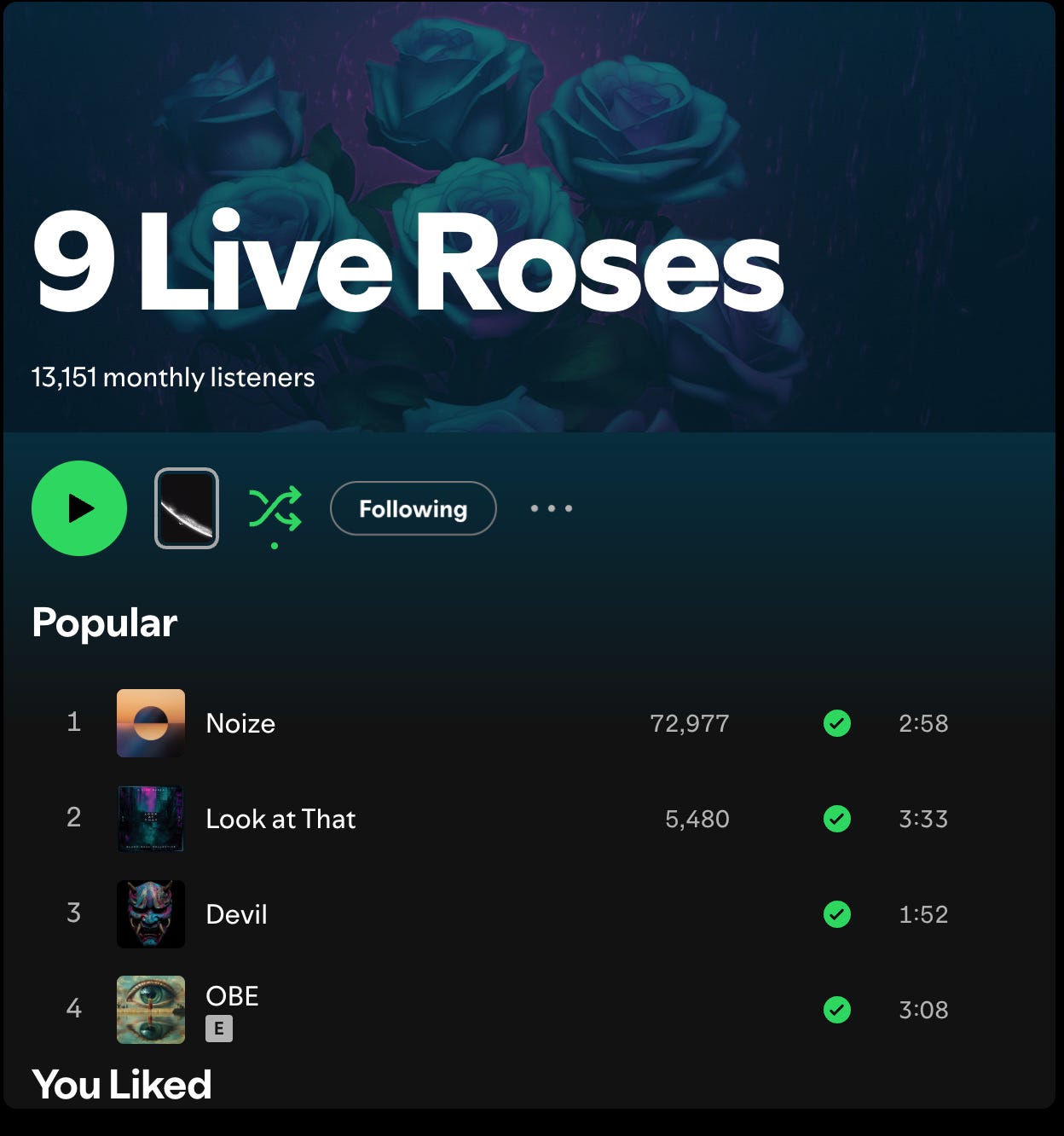
I started releasing every month in December of 2025. Right before Dax was born.
That was the moment I knew that if I didn’t start releasing my own music, I never was going to start. I’d been making records for other people for years. My own work sat on the shelf. The catalog of finished, unfinished, and half-formed songs kept growing in the project folder and the world never heard any of it. I’d convinced myself I was building toward some better-prepared version of the release, some season when the timing would be obvious.
The truth is the timing’s never obvious. It’s just the season you decide to ship.
The push for 9 Live Roses didn’t come from ambition. It came from something underneath ambition. Marcus Aurelius wrote, “You could leave life right now. Let that determine what you do and say and think.” That line has sat with me for years. The Stoics weren’t being morbid about it. They were being operational. The point of remembering you’re going to die isn’t the dread. It’s the decision the dread forces.
I think about my own death constantly.
If that sounds dark, that’s fine, but it’s the engine. The question I ask myself most weeks is the same one. If I died today, would I be content with what I’m leaving? The answer is what pushes me past where I think I’m capable. The answer is what makes me ship the song instead of polishing it for another six months. The answer is what made December 2025 the month the monthly release cadence started, instead of “next year” again.
Legacy isn’t only the music. It’s the way I share information. The way I shape the younger generation of engineers coming up behind me. The catalog of records under 9 Live Roses is one piece of it. The way I teach is another. Both pieces are the legacy. Neither was going to build itself.
Noize, the first release in the cycle, just crossed seventy-three thousand streams across twenty-eight thousand listeners. The numbers don’t matter as flex. They matter as proof the decision was the right one. The song was waiting to leave the shelf.
The Substack stayed quiet during the build. That was the trade. I’m not going to apologize for it because the trade was the right one.
Sharing Knowledge

In May I was teaching a live session at The Quad in New York City. Mastering.com had flown me out. One of the students I was working with one on one was blind.
He sat at the console. He set up his session by ear, by touch, by the memory of where the controls live in the software he’d learned to navigate without seeing them. He mixed a record in front of me. Then he turned and played it for the room.
It was good. Really good.
I watched the room before I watched him. The other students had stopped what they were doing. Nobody was on their phone. Nobody was half-listening. The producers in the chairs around us were leaning forward into the speakers the way you lean into a mix that’s telling you something you didn’t know you were waiting to hear. One of them, an engineer maybe ten years into his own career, looked at me without saying anything. I knew what the look was. The look was: I’ve been making excuses about my own work for a year and this kid just deleted every one of them.
That’s the moment that stayed with me. Not the mix. The room’s response to the mix. The way it reset everyone in it, including me.
Limitations are inputs, not stops. The student earned that mix. He didn’t earn pity for working past a hard limit. He earned respect for refusing to let the limit decide whether the work got done. That distinction is the whole game.
The road work itself was its own education. Mastering.com flew me to studios I’d only heard about in passing for years. June Audio in Provo. The Hideout in Las Vegas. NRG in Los Angeles. The Quad in New York City. Sitting in those rooms with engineers I’d respected from a distance showed me something I needed to see.
The lane I’d built was its own thing.
I’d put sixteen years into producing and mixing all in the box, working out of New Mexico, without a commercial-studio resume, without the music-city connections that get most engineers their first break. Watching the engineers in those rooms confirmed what I’d suspected. The in-the-box path I’d taken isn’t a lesser version of the legacy path. It’s a parallel path, with its own discipline and its own results. The road trips didn’t disqualify the lane. They certified it.
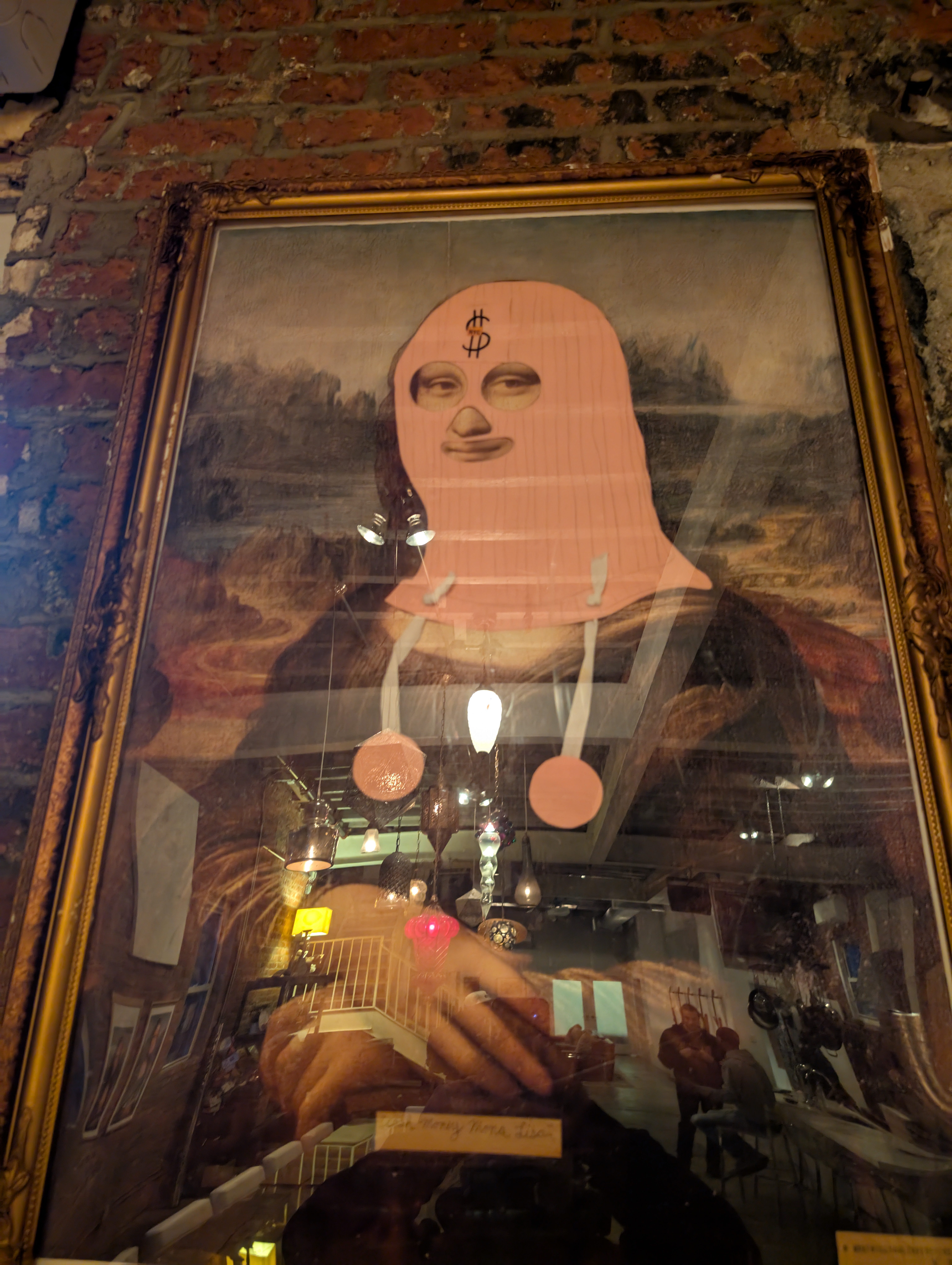
One night an intern at The Quad walked me to a secret studio across the city. The kind of room you only see if someone inside takes you in. More money in that room than in The Quad itself.
But the deepest part of the year wasn’t the studios. It was the students.
The stories they shared at live events about what they were struggling with. The live format itself, the room with the speakers and the chairs and the producers actually present, resetting them creatively in ways the asynch formats never quite do. I went out expecting to teach. I came back having watched the students teach each other, and teach me, in ways I couldn’t have engineered if I’d tried.
Black Soul Collective
For years I worked with private clients through word of mouth and direct outreach. People who knew people. Producers I’d connected with in DMs. Artists who’d heard a record I’d mixed and tracked me down.
What I didn’t have was a place that was an open book. A surface where someone could come and hire me for the engineering work without having to know me personally first. Word of mouth scales until it doesn’t, and the ceiling on it is the relationship density of the network you’ve built. I’d hit that ceiling.
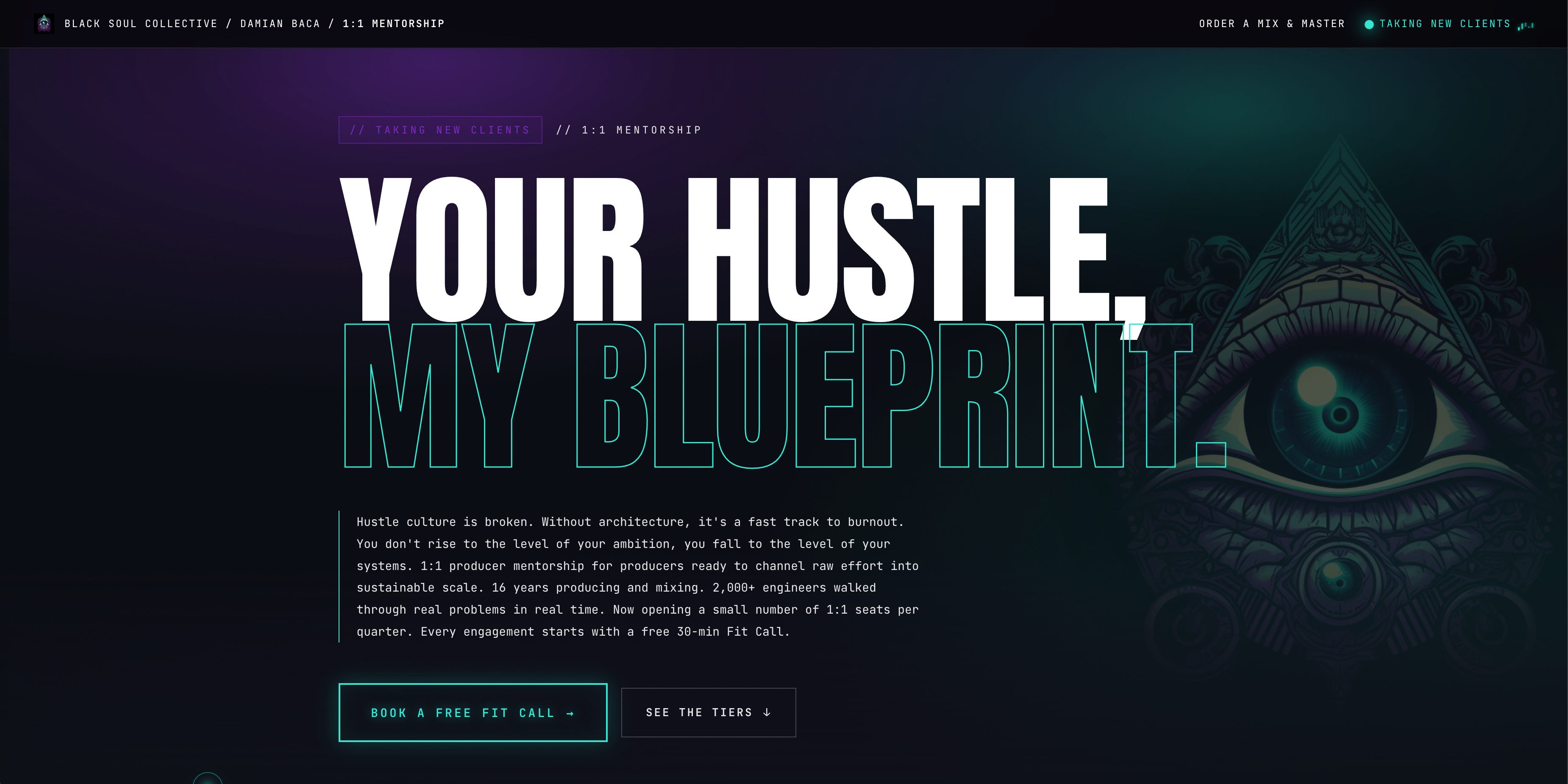
Black Soul Collective is the Chamber where the engineering work happens. Open book. Public-facing. The mix and master pricing is on the page. Anyone who wants to bring me a record can do it through the surface without a warm intro. That’s the structural piece that didn’t exist a year ago and exists now.
The mentorship offer came out of the same recognition. Sixteen years of producing and mixing reached a critical mass during the road year. I’d trained 2,000+ engineers through Mastering.com by then, watched what works and what doesn’t, watched where producers actually get stuck versus where they think they’re stuck. The accumulated pattern recognition is its own asset, and at some point you have to decide whether to keep it private or build a surface that lets people pay for direct access to it.
I built the surface. soulcollective.black/coaching is where it lives.
Architecture follows readiness. That’s the principle. Don’t build the public surface before you’ve built the standing that earns it. I waited longer than I had to on both of these because I wanted the standing first. The standing’s there now, and the surfaces caught up with it.
Bitwig Certified Trainer

In April I sat for the Bitwig Certified Trainer cohort.
A cohort of roughly twenty producers and engineers from around the world. The instructor was Thavius Beck, whose own teaching career is its own kind of legacy, and whose presence in the room reset what the standard looked like before the first session even started.
The cohort was the most refreshing thing I’d done all year. Sitting with people who were every bit as good as me, in some areas better, working through software I’d been using daily for years and finding rooms inside it I hadn’t entered before. The trial itself pushed me to articulate what an effective teacher actually does, not just what an effective producer does. Those are different jobs, and the certification process makes you separate them.
I thrived in the presentation portion. I’m teaching live almost every day through Mastering.com, so the muscle was already there. Passing the certification and being welcomed across the trainer community felt like something earned, not something gifted.
Here’s the part that mattered most. The day you think you know is the day you stop growing. Sixteen years into the craft, sitting in a cohort with people I could learn from in real time, was the reminder I needed that the work isn’t a destination. The work is the work, and the day you start thinking the credentials add up to “arrived” is the day the craft starts going backwards on you.
The Bitwig credential isn’t the receipt. The reminder, that the beginner’s mind is the engine and not the obstacle, that’s the receipt.
Don’t Dilute Your Vision
Five receipts. None of them about cataloging the year.
They're about what directed attention actually produces when you stop trying to keep every surface alive at once. Dax. The music. The road. The architecture. The cohort. None of those got built by accident.
Focus is always happening. The question is, what are you pointing it at.
The Substack silence wasn’t the absence of focus. It was the cost of pointing the focus at the five things you just read. The trade was deliberate. The other surfaces I let go quiet during the build were not failures of discipline. They were the lesser priorities I let fall silent so the projects worth protecting could actually get protected.
That’s the discipline lesson. The projects worth protecting are the ones you let the lesser priorities fall silent around.
If you’re in a season where you’re trying to keep too many surfaces alive at once, and you can feel the dilution starting, that’s not weakness. That’s information. The fix isn’t more discipline. The fix is the decision about which one stays loud and which one goes quiet for a season, on purpose, so the loud one can hold.
To the subscribers who stayed on this list through thirteen months without a single post landing in your inbox: thank you for the patience. I’m not going to perform gratitude about it. I’ll honor it by writing something worth opening every week from here on out.
The cadence picks back up now. Different reason each week. Same operating system underneath.
I missed this part. I forgot how much I missed it until I sat down to write this one. Mixing a record and writing an essay use different muscles, but the cathartic part of both is the same, you sit with the raw material and you put it in an order that wasn’t obvious before you started.
Weaving thoughts in and out is its own kind of mixing.
Glad to see you back at this, man. Your attitude, determination, commitment, and execution are something to aspire to. Thanks for sharing your thoughts and insights… they inspire me to dig deeper, while not pushing myself towards an early grave. Wolverine’s where it’s at!
That beginner mindset is golden. It’s refreshing to hear a seasoned pro like yourself keeping your mind fresh with a constant stream of new knowledge… another thing we should all aspire to.
You’ve got me rethinking so much with this one…
Looking forward to more from that beautiful mind of yours ❤️
Welcome back!